
What is CPAM?
A guide for families

This guide explains what CPAM/CCAM (Congenital Pulmonary Airway Malformation) is and how CPAM is managed and treated.
Medically reviewed by Marisa Schwab, MD
Written by Emily Lake, PhD
Last updated 05/04/2026
What is CPAM?
CPAM (congenital pulmonary airway malformation), previously known as CCAM (congenital cystic adenomatoid malformation), is the most common type of congenital lung malformation (CLM). CPAM is a benign (non-cancerous) mass of abnormal lung tissue that usually develops in one lung lobe early during pregnancy. A CPAM does not function like normal lung tissue. Most CPAMs are discovered during a routine prenatal ultrasound around 20 weeks of gestation. The diagnosis can feel very overwhelming.
The mass develops in the lungs very early during pregnancy, sometime before the 10th week of gestation. The CPAM mass can be cystic (fluid- or air-filled spaces), solid, or spongy. The lung tissue that is affected doesn’t work normally, but the rest of the lung—and the other lung lobes—usually develop and function well.
Most CPAMs will shrink before birth and the majority of babies (up to 90%) are asymptomatic, meaning they have no breathing problems when they are born. If surgeons recommend that the CPAM and affected lung lobe should be removed after birth, the healthy lung tissue will expand to fill the space left behind. The vast majority of kids will have no serious long-term impacts on their health or activity levels.
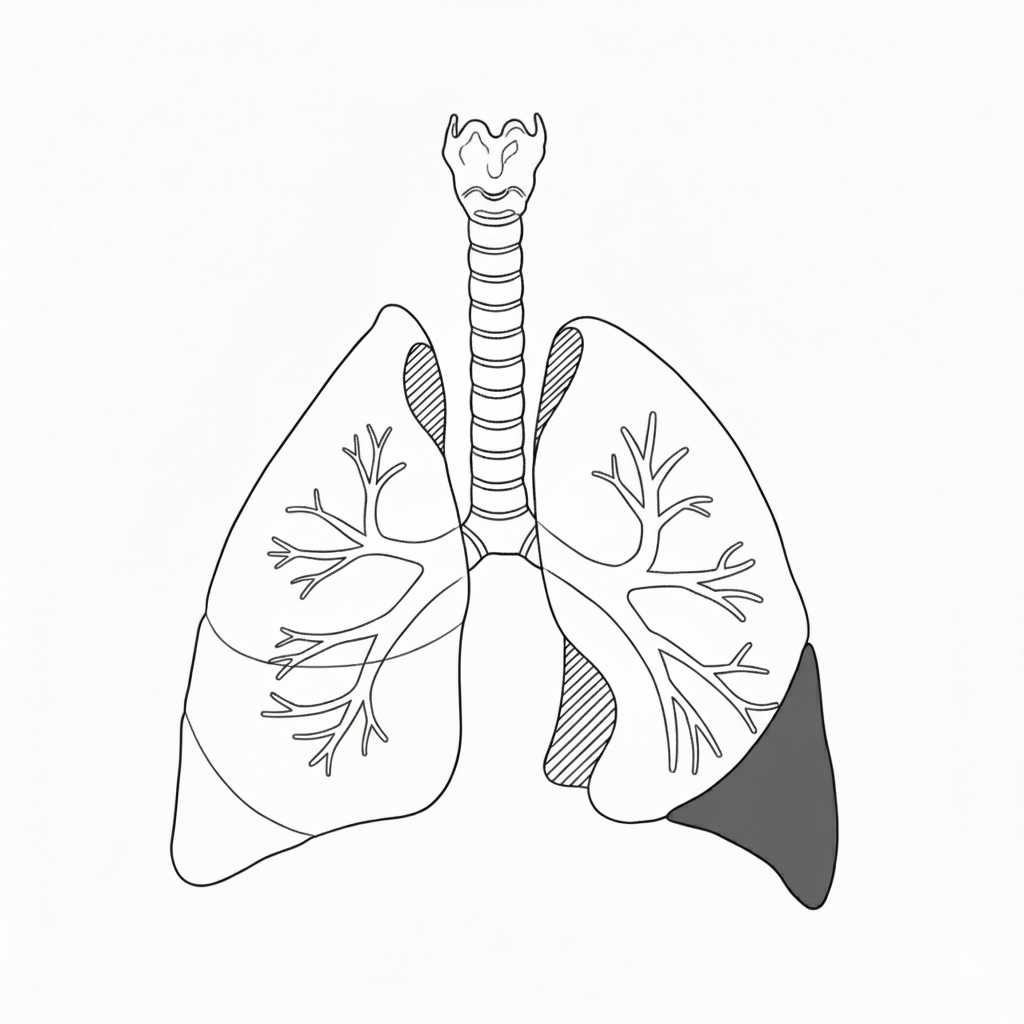
A sketch of the lungs with a CPAM mass (shaded) in the lower left lobe.
What causes CPAM?
Nobody knows for sure but CPAM is not caused by anything the mother did, or didn’t do, during pregnancy. Congenital lung malformations like CPAM are believed to be random.

Why did this happen? Understanding how congenital lung malformations develop
Lung malformations arise from deeply complex biological processes that take place in the earliest weeks of pregnancy, long before most people even know they’re expecting.
Mass vs lesion vs cyst
You’ll see all three of these terms used almost interchangeably when talking about CPAMs.
Mass: A general word doctors use for an abnormal growth of tissue. Masses can be benign (non-cancerous) or malignant (cancerous). CPAM is benign: it is not cancer.
Lesion: A broad medical word for an abnormal area of tissue. With CPAM, it means the same thing as “mass” or “the CPAM.”
Cyst: A fluid- or air-filled space. In CPAM, the affected area may contain one or more cysts, which can be large and easy to see or so tiny that the area looks more solid on imaging.

What do we actually know about lung malformations? Q&A with Dr Shaun Kunisaki
We spoke with Dr Shaun Kunisaki—Professor of Surgery at the Johns Hopkins School of Medicine and a Medical Advisor to the CLM Society —about what we actually know, what’s still debated, and what researchers and clinicians are working hard to understand next.
CPAM types
You might see references online to CPAM “types” also referred to as the Stocker classification. It’s possible someone on your medical team has even mentioned them. However, clinicians who specialize in treating and studying lung malformations are increasingly not using them. The types system was not great at reflecting postnatal diagnosis (when a pathologist looks at the CPAM after surgery) or predicting postnatal outcomes, like if the baby would need help breathing or not. Instead, a better classification that is increasingly used nowadays is whether the lesion appears to be microcystic (or solid) vs macrocystic on an ultrasound.
Macrocystic CPAM
the affected lung tissue is made up of one or more fluid-filled cysts
the CPAM appears dark on ultrasound
if intervention is needed this may include steroids, thoracentesis and/or a thoracoamniotic shunt
the size, growth pattern, and whether the CPAM is causing other problems are all more important than the name alone
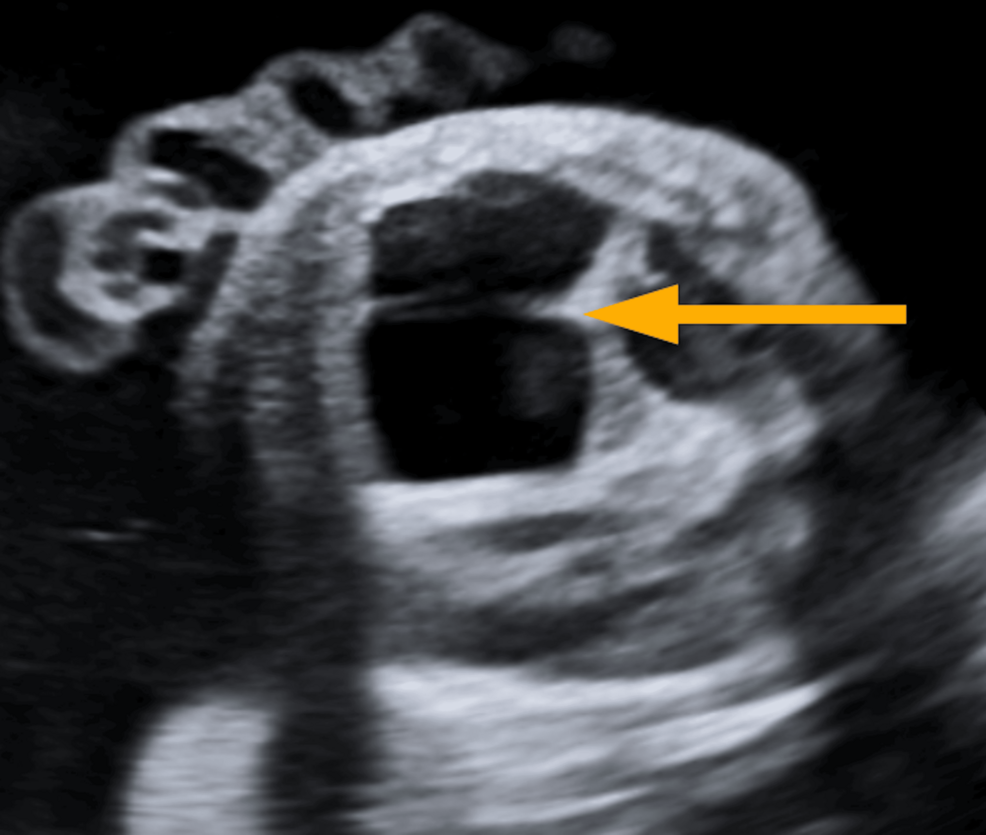
A macrocystic CPAM on ultrasound appears darker than the surrounding lung tissue. Image: Sathian et al (2026)
Microcystic CPAM
the affected lung tissue may look solid or made up of many tiny cysts packed closely together
the CPAM appears bright on ultrasound
if intervention is needed this may include steroids and in extremely rare cases fetal surgery
the size, growth pattern, and whether the CPAM is causing other problems are all more important than the name alone

A microcystic CPAM on ultrasound appears brighter than the surrounding lung tissue. Image: Jordan (2016)
How rare is CPAM?
Congenital lung malformations, including CPAMs, are uncommon. Estimates for all lesions are 1 in 2,500 live births. CPAM is the most common congenital lung malformation. Currently, approximately 70% of babies with a CLM are diagnosed before birth.
Cancer risk and CPAM
A very small number of patients with CPAM develop cancer, but researchers don’t know if the CPAM was actually mistaken for an extremely rare cancer (less than 1/100,000 people) called Pleuropulmonary blastoma (PPB) or whether the CPAM turned into a cancer later in life. More research is needed to truly understand the relationship between CPAM and cancer.
What is the prognosis?
The prognosis for a baby born with CPAM is excellent. In the overwhelming majority of cases CPAM will not affect a child’s life expectancy or quality of life. In some rarer cases, the CPAM presents more serious complications during pregnancy or immediately after birth. In particular, if the CPAM grows very quickly, or is very large, fluid can build up in nearby organs. This build up of fluid is a rare but very serious condition called hydrops. When the CPAM is more dangerous, the pregnancy must be extremely carefully monitored by specialists.

What to expect during a CPAM pregnancy?
A CPAM diagnosis during pregnancy is a significant and disruptive experience. Read our guide on what typically happens during a CLM pregnancy in terms of appointments, monitoring, and who will be on your care team.
Management and treatment
There are two main paths for CPAM management and treatment. Which one you choose depends on the specifics of your baby’s CPAM, the advice of your medical team, where in the world you are located, and what you feel is best for your child.
Elective surgical removal
Most often a thoracoscopic or open lobectomy in later infancy— normally around 3–6 months—even if a child has no symptoms. This is the common treatment path in the USA and means that the surgeon will remove the entire affected lung lobe. The reason this is recommended by most doctors in the USA is to prevent repeated and severe infections (such as pneumonia) for the rest of the patient’s life, make the diagnosis certain, and address the very small risk of cancer. The recovery time depends on whether the operation is done via the open or minimally invasive technique. After a thoracoscopic lobectomy, babies usually recover quickly and spend one or two days in the hospital. The remaining lung will expand and grow to compensate for the removed lobe, and most children will have the same lung function as someone who didn’t have lung surgery as a baby. They’ll be able to do all the activities and sports they want when they grow up.
Careful observation (“watchful waiting”)
Scheduled check-ins and regular imaging. This is the common treatment path for patients with asymptomatic CPAMs in Canada, Australia, and many European countries. If symptoms develop—recurrent chest infections, wheezing not explained by common causes, or a spontaneous pneumothorax—surgery is then usually recommended.
For the majority of babies without hydrops during pregnancy, survival is near 100% and long-term outcomes are excellent. Even for larger CPAMs, modern prenatal monitoring and the use of steroids or shunts have improved outcomes. After birth, surgical removal is considered curative.

Need to talk to someone who gets it?
Connect with one of our trained peer support counselors who understands what it is like to get a CPAM diagnosis. We are an international team of parents who have been through a CLM diagnosis with our babies. We can help you understand your diagnosis, prepare for appointments so you can have better conversations with your care team, and help you navigate your fears and anxieties.